
Sticking Three Reformers in a Cupboard Does Not Make You a Pilates Studio
Right, we need to talk about this.
Every gym in the country has, in the last eighteen months, found a spare room roughly the size of a large shed, wedged in three reformers, hung a canvas print that says "Breathe" on the wall, and started selling "Pilates classes." No idea who Joseph Pilates is. No idea what the repertoire is. Just a resistance machine and a Spotify playlist called Vibes For Girlies.
We are going to lose our minds if we do not say something, so here we are, saying something.
Who Actually Started This
Joseph Pilates did not invent a reformer and call it a day. He built an entire system, and it took him decades.
He started with mat work. During the First World War he was interned on the Isle of Man, and while he was there he began developing a method of conditioning using nothing but the floor and your own body. He called it Contrology, which is a much better name than Pilates if we are honest, but here we are. Years later he wrote it all down in a book called Return to Life Through Contrology, which is still the closest thing the method has to an original manual.
Here is the bit everyone skips. Once Joe had his mat system properly built out, he noticed something: some of these movements were genuinely tough to access. Not everyone's body could get into the same shapes with the same control straight away, no matter how much they wanted to. Rather than shrug and say "some bodies just can't," Joe went the other way. He started inventing equipment that could take a mat exercise and break it down, support it, load it, or open it up, so that more bodies could actually get into the system and progress through it properly. That is where the Reformer came from. And the Cadillac. And the Chair. And the Barrel. He patented the lot. This was not improvised. This was a man, way ahead of his time.
So the Reformer was never the point. It was one tool, built to serve a much bigger, much more precise system that Joe spent his whole life refining.
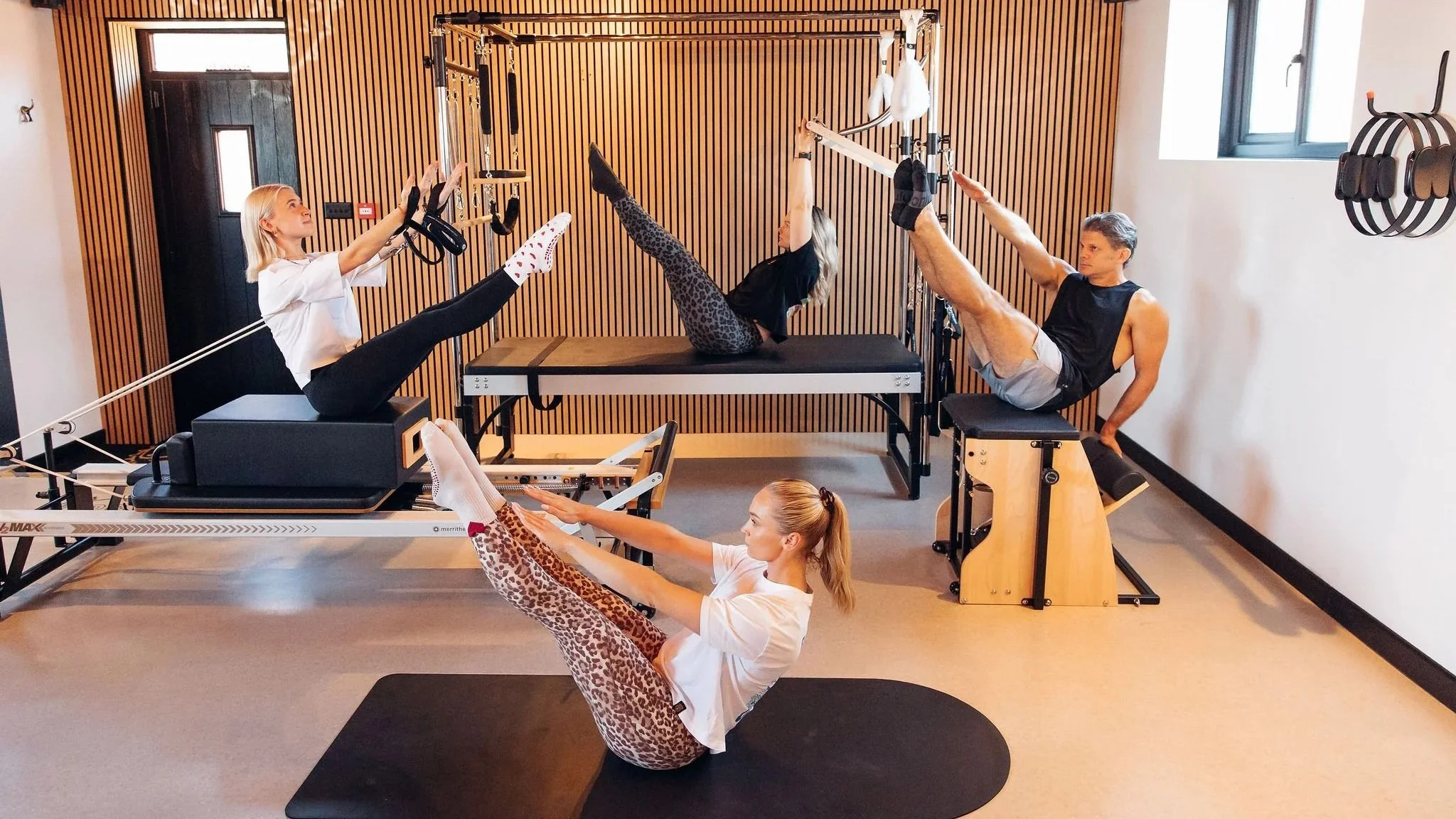
Different versions of the Teaser across the equipment.
Then Everyone Fell Out, As You Do
After Joe died, the people who had trained directly under him split into camps, because of course they did. They are often referred to as the 'Elders' which is why people like to call Pilates a cult.
You have got the Classical school, who believe the order matters, the sequencing matters, and the original repertoire as Joe and his closest students taught it should be preserved pretty much exactly as it was. Think of it as the purists.
And you have got Contemporary, who took the same foundational principles and let them evolve, pulling in modern movement science, biomechanics, and a willingness to adapt exercises for different bodies and goals, without treating the original order as sacred text. These believe Joe probably would have evolved his work, but who truly knows?
For years these two camps genuinely went at each other. Classical instructors thought Contemporary teachers were diluting the method. Contemporary instructors thought Classical teachers were stuck rehearsing a museum piece. It was proper tote bags at dawn in the Pilates world, which, if you have never witnessed a row between two Pilates instructors about lineage, is a genuinely special experience. Check out Instagram and you won't have to look far.
The Actual Problem Now
Here is the thing though. Ask most Classical and Contemporary teachers today and they will tell you the fight feels almost quaint, because a much bigger issue has turned up: an enormous number of people teaching "Pilates" who know neither school, because they were never taught either one.
That is the actual state of play right now. Someone completes a weekend course, an online course, or sometimes doesn't even bother with that, gets handed the keys to a room full of reformers, and starts running sessions with zero grounding in the principles, the repertoire, the order, the intention behind any of it, or what the movement is even meant to be doing to your body. It becomes generic resistance training on a sliding platform, set to music, with cues like "and squeeze" repeated for fifty minutes.
That is not Pilates. That is a gym class that has borrowed a Pilates shaped machine. It is painful for those of us that have spent years refining our skills, and continue to do so.
Both camps, Classical and Contemporary, actually agree on more than they disagree on these days, because the shared issue is bigger than either of them. It is studios with rows of reformers and nobody in the room who has done more than a few days of training. It is nobody doing a proper risk assessment before they put a client on a machine that can genuinely hurt someone if it is set up wrong. It is the industry getting so big, so fast, that the actual method is getting left behind entirely.
Why We Bang On About This
We are not precious about which camp is "right." Frankly we think a good teacher borrows the best of both and knows exactly why they are doing what they are doing, in what order, and what it should be doing to your body.
What we are precious about is the method. The system Joe spent his life building was specific, layered, and genuinely clever, and it deserves better than being reduced to "lie on this machine and pull some straps" from an instructor that has qualified online.
So next time you book a class, ask what your teacher trained in. Ask how long their training took. Listen if they name moves ‘Elephant, Swan, Mermaid'‘ - that is a green flag. However, ff the answer is "a weekend" and a shrug, you have found yourself in a cupboard with reformers in it, not a Pilates studio.
Big Vibes,
Millie